
- News
- Relationships News
- 8 things hiring managers notice within seconds of opening your resume
8 things hiring managers notice within seconds of opening your resume
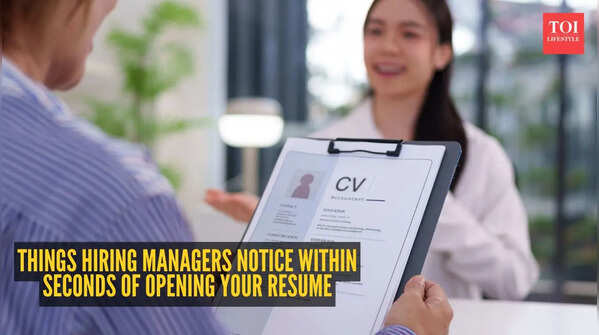
8 things recruiters first notice in CVs
Let’s be honest: the modern job hunt is brutal right now. Even if you have a great degree and a decade of solid experience, getting a simple callback feels like shouting into a void. We’re constantly told to keyword-stuff our resumes and hack the ATS algorithms, but we rarely talk about what happens when a living, breathing human actually opens the file.
A recent viral Reddit post by an ex-recruiter-turned-resume writer revealed the truth about hiring. It turns out, hiring managers make up their minds in seconds, and it usually comes down to things you didn’t even realise you were projecting.Here is the unfiltered truth about what employers are actually looking for when they scan your resume.

They want to pinpoint your exact level, instantly
Recruiters don't have the time to play detective. The moment they open your file, they are looking for a very specific zone of seniority.
"Within seconds a hiring manager is trying to figure out if you are the right level for the role.Not too junior, not too senior. If that is not immediately clear from the resume it gets put aside before anything else."
If you’re aiming for a mid-level role but your resume reads like an intern's daily log, you're out. If you look overqualified but don't explain why you want this specific step, you're also out. Your title, your scope, and your responsibilities need to scream your exact career stage from line one.

Stop throwing random percentages around
We’ve all heard the advice: "Add metrics to everything!" But throwing random numbers onto a page just to check a box backfires completely.
"Not every bullet needs a metric but the ones showing real impact do. Not percentages thrown in for the sake of it.Specific outcomes only you could have produced."
Saying you "increased efficiency by 15%" without explaining how or why it mattered is just background noise. If a number doesn't show a direct, meaningful result, like money saved, revenue generated, or hours clawed back, leave it out. Context is what makes a number powerful.

Proof beats potential every single time
Companies are risk-averse, especially in a tough market. They aren’t looking to train someone up if they can avoid it; they want solutions to the problems.
"Evidence you have actually done the thing they are hiring for. Not that you could probably do it. That you have done it." Transferable skills are great, but hard evidence is better. Don't promise what you can do. Prove what you’ve already done with concrete examples of past wins.

Shrink your history as you go back
Your resume shouldn't be a comprehensive autobiography.The older the job, the less space it deserves.
"A resume that gets shorter the further back it goes. The most recent role gets the most space. Roles from ten years ago get almost none."
Hiring managers care about who you are today, not who you were a decade ago.Write more about your last two or three roles. For that entry-level job you had in 2015? A single line with your title and the company name is enough.

Pass the "smell test" for consistency
When a resume feels disjointed, it triggers red flags. Recruiters look for alignment between your title, your actual tasks, and the impact you claim to have had."Consistency between the title, the work and the level of impact. When all three match it reads as credible."
If your title says "Lead Strategy Director" but your bullet points describe basic data entry, the math doesn't add up. When your titles match the actual weight of your achievements, you build instant trust. When they don't, you look like you're exaggerating.

Answer the "So what?" question
If 50 people apply for the same role, chances are most of them have a similar background. You have to give the hiring manager a reason to pick your file out of the stack.
"An answer to the question why this person and not someone else with the same background."
What is your specific superpower?Maybe it's your niche industry knowledge, a unique combination of skills, or a track record of fixing broken processes.Don't just list what you did; highlight what makes you different.

Eliminate the "Friction"
Every time a recruiter has to stop and wonder what a sentence means, you lose ground. The post defines "friction" as anything that slows the reader down.
"Every vague phrase is friction. Every unexplained gap is friction. Every question the resume raises without answering is friction."Confusing company jargon, mysterious gaps in employment, or vague descriptions of projects cast doubt. Clear the hurdles for them. Make your resume so smooth and easy to read that they can grasp your value proposition in a single, effortless scan.

Ditch the AI buzzword soup
With the explosion of generative AI, every recruiter's inbox is flooded with resumes that sound flawless, sterile, and entirely identical.
"(Your CV should have) Language that sounds like a real person wrote it. Hiring managers read AI-generated resumes all day."
So, write the way you actually speak.Use natural phrasing, own your achievements, and let your human voice cut through the digital noise.
Featured In Relationships

