Desert bloom
Desert bloom
You're Reading


Synopsis
The National Museum of Qatar, in Doha, lures visitors with its dramatic facade, only to have them find that the real treasures lie within. The building before me stands tall, with not a straight line in sight. The roof appears to … Read more
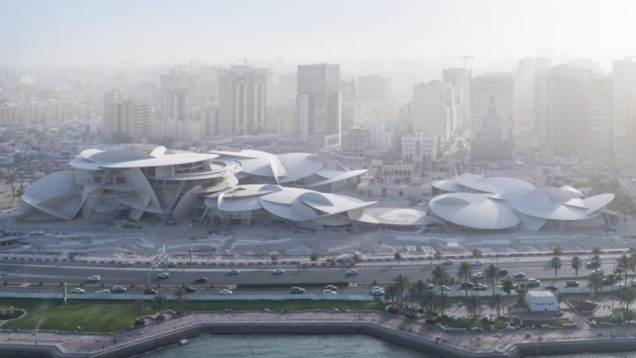
The building before me stands tall, with not a straight line in sight. The roof appears to be a series of discs, that have bumped into each other, albeit gently. On cue, a wide-eyed little boy next to me, asks his mother aloud, “Is this a flying saucer?” And I see exactly where he is coming from. This bizarre and beautiful structure is the National Museum of Qatar (NMOQ), set in the capital city of Doha. The ambitious architectural project was brought to life by French architect, Jean Nouvel, the man behind the Louvre Abu Dhabi. Ever since its opening on March 28, 2019, visitors have ventured many guesses with respect to its design: an allegory for the circle of life, or more flippant deductions such as a ‘tribute to a frisbee’. But take a step back — literally and in time — and you’ll see that the clever design is a desert rose.


With a gorgeous exhibit within the museum, the desert rose is a crystalline cluster of gypsum that forms in the deserts of Qatar. Nature shapes these blocks in such a way that it looks like a sand-coloured rose in bloom. Despite the name and form, this ‘rose’ is no plant; it is, in fact, a rock. And it is probably the first architectural structure that nature created here, making the museum-building an apt metaphor for the region.
Within the rose — which covers a whopping 4,30,000 sq feet — unfolds the story of Qatar. Immersive galleries take me back in time, some 700 million years ago. I discover that the earliest inhabitants, despite the vast sand-scapes, were marine creatures. It serves as a reminder of the unique geology of Qatar — perched on the edge of the Persian Gulf — that has sustained colonies of sea turtles, crocodiles and even dugongs.
In this museum, you can find a glittering piece of India – the Pearl Carpet of Baroda. Commissioned by Maharaja Gaekwar Khande Rao of Baroda, it comes studded with half-a-million pearls, as well as diamonds, sapphires, emeralds and rubies. It was originally intended as a gift for the tomb of Prophet Mohammed at Medina.
Also visit
Set in the MIA Park on the Doha waterfront, the Museum of Islamic Art stands out as an architectural gem. Once inside, you will see masterpieces, including metalwork, ceramics, jewellery, woodwork, textiles and glass, collected from three continents and dating from the 7th to the 19th century. Entry to the museum is free.

closecomments

Be the first one to review.
We have sent you a verification email. To verify, just follow the link in the message
end of article

Visual Stories
10 pretty Indian villages to visit this year-end
8 castles in Germany straight out of a fairy-tale

8 tiger reserves every wildlife enthusiast should visit in India

10 animals that are easily spotted in Ranthambore National Park
How to prepare for a night safari in India?
9 rare animals to spot in the Western Ghats and where to find them



Trending Stories
At this village in Karnataka, farmers discuss Shakespeare, Hemingway and Kalidasa: How to reach and what to see
From lounges to last-minute deliveries — here's what's waiting for you at the Chhatrapati Shivaji Maharaj International Airport
From gym runs to weekend getaways: Why versatile bags are becoming travel and everyday essentials
I usually laughed off ghost stories — until one freezing night in West Sikkim changed everything
India's 'Mountains of Death' is not actually a mountain – what and where is it?



Comments (0)