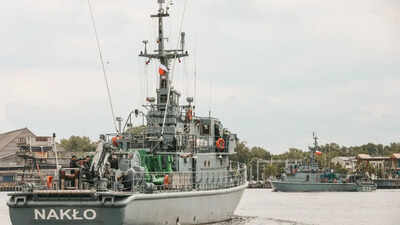
Nato's flagship naval exercise, BALTOPS (Baltic Operations), is set to begin on 4 June, though on a smaller scale than last year. The exercise will involve around 20 warships, 6,000 personnel and participants from 15 nations, making it roughly half the size of the 2025 edition.
The drill comes at a time when allied forces remain stretched across multiple theatres, from West Asia to the Arctic, highlighting the growing challenge of maintaining deterrence against Russia while responding to crises in different regions. Last year's exercise involved more than 40 warships, 25 aircraft and 9,000 personnel, making it one of Nato's largest maritime drills in the Baltic Sea
German Rear Admiral Stephan Haisch described the exercise as "a sign of the alliance's unity and strength" and said it would remain the largest maritime exercise in the Baltic Sea. He also underscored the multinational character of the operation, which is being conducted under US leadership with broad participation from Nato members.
BALTOPSThe Baltic Operations exercise was launched by the US Navy in 1971 at the height of the Cold War to strengthen cooperation among Nato navies operating in the Baltic Sea. At the time, the Baltic region represented a critical frontier between Nato and the Soviet Union, making maritime readiness and interoperability essential.
Following the collapse of the Soviet Union in 1991, BALTOPS expanded to include countries from Central and Eastern Europe. The exercise now encompasses amphibious operations, anti-submarine warfare, mine countermeasures, air defence and joint operations involving naval, air and land forces.
The strategic importance of BALTOPS increased significantly after Russia's annexation of Crimea in 2014, prompting Nato to place greater emphasis on its eastern flank. Following Russia's full-scale invasion of Ukraine in 2022, the exercise gained even greater prominence and became a key demonstration of Nato's ability to reinforce and defend the Baltic region.
Strategic importance of the Baltic SeaThe Baltic Sea holds considerable strategic importance despite its relatively small size. Bordered by Russia, Germany, Poland, Finland, Denmark and the Baltic states, it serves as a crucial corridor for military movement, trade and energy infrastructure.
Following the accession of Finland and Sweden to Nato, almost the entire Baltic coastline is now under the control of alliance members. Russia's access to the sea is largely limited to Saint Petersburg and the heavily militarised exclave of Kaliningrad.
The Baltic Sea is also home to critical undersea infrastructure, including gas pipelines, electricity interconnectors and telecommunications cables linking Northern and Eastern Europe. The sabotage of the Nord Stream gas pipelines in 2022 exposed the vulnerability of this strategic infrastructure.
BALTOPS 2026 comes at a time when the global security environment is under increasing strain. From the war in Ukraine to instability in West Asia and growing competition in the Arctic and Indo-Pacific, the exercise highlights Nato's efforts to balance competing priorities while maintaining credible deterrence along its eastern flank.
For Nato, the challenge is no longer preparing for a single conflict but sustaining readiness across multiple flashpoints around the world.