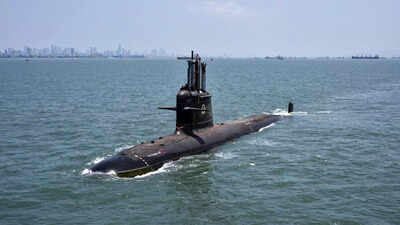
Australia, the United States and the United Kingdom have agreed to modify key elements of the AUKUS submarine partnership, with Canberra now set to receive only operational Virginia-class submarines rather than a combination of new and in-service vessels.
The announcement was made on Saturday during the Shangri-La Dialogue in Singapore, a major security forum attended by defence ministers, military officials and strategic experts from around 45 countries.
Under the AUKUS pact signed in 2021, Australia is expected to acquire at least three Virginia-class nuclear-powered submarines from the United States over the next 15 years as part of a broader effort to strengthen its naval capabilities.
In a joint statement, Australian deputy prime minister Richard Marles, US defence secretary Pete Hegseth and UK Defence Secretary John Healey confirmed the revised arrangement.
"The deputy prime minister and secretaries welcomed the proposed approach to streamline Australia's acquisition of Virginia-class submarines (VCS), simplifying supply chain management, operational and maintenance requirements, and maximising cost efficiencies," the statement said.
"This approach would enable Australia to acquire three in-service VCS in lieu of a mixture of new and in-service VCS variants."
The change comes as the US Navy faces production challenges with its Virginia-class programme. Although the United States currently operates 24 submarines of the class, shipyards have struggled to meet the target of building two new vessels annually.
The original plan envisaged Australia receiving two existing submarines and one newly built Virginia-class boat.
The arrangement has also attracted criticism in the United States, where some lawmakers and analysts have questioned the wisdom of transferring advanced nuclear-powered submarines to an ally while the US Navy continues to face its own fleet requirements.
The submarine component remains the centrepiece of Australia's long-term defence strategy. According to government estimates, the broader AUKUS submarine programme could cost as much as US$235 billion over the next three decades.
What is AUKUS deal?
The AUKUS deal is a trilateral security partnership between Australia, the United States and the United Kingdom, announced in September 2021 to strengthen military and technological cooperation in the Indo-Pacific region.
The centrepiece of the agreement is a plan to equip Australia with conventionally armed, nuclear-powered submarines, making it only the second country after the UK to receive such technology from the United States. Under the arrangement, Australia is expected to acquire at least three US Virginia-class submarines before jointly developing a new class of submarines known as SSN-AUKUS with Britain.
Beyond submarines, AUKUS also covers cooperation in advanced defence technologies, including artificial intelligence, cyber capabilities, quantum computing, undersea systems and hypersonic weapons.
The partnership is widely viewed as a strategic response to China's growing military influence in the Indo-Pacific. While supporters argue it will enhance regional deterrence and security, critics have raised concerns about costs, nuclear proliferation risks and whether the US and UK can meet submarine production targets while maintaining their own naval readiness.