
GMRT discovers five new pulsars in ancient star clusters
Jun 11, 2026, 12.20 AM IST
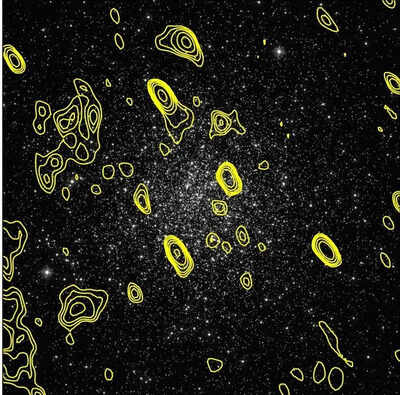
Pune: A team of astronomers led by doctoral student Jyotirmoy Das at the National Centre for Radio Astrophysics has discovered five new millisecond pulsars in the ancient globular clusters Messier 69 and Messier 70.
Using India’s upgraded Giant Metrewave Radio Telescope (uGMRT), the team made the first-ever pulsar detections in these clusters, offering new insights into some of the oldest and most densely packed stellar systems in our galaxy.
As millisecond pulsars rotate, they emit beams of radio waves that sweep across space like lighthouse beams. Because of their remarkable stability and precision, millisecond pulsars serve as natural cosmic clocks, helping scientists study gravity, stellar evolution, and the dense environments of ancient star clusters.
Lead author Jyotirmoy Das said, “Globular clusters are among the oldest stellar systems in the Milky Way and pulsars provide a highly precise way to study them. Their extremely stable rotation makes them sensitive probes of even tiny changes within a cluster. Finding multiple pulsars in the same cluster allows astronomers to measure subtle variations across different regions with exceptional accuracy.”
In this study, researchers discovered five millisecond pulsars—two in M69 and three in M70. One of them, M69A, is in a close orbit with a companion star, likely a white dwarf, completing an orbit every few days. Such systems are common in the crowded cores of globular clusters, where stars frequently interact and exchange companions.
The remaining pulsars show a variety of characteristics, with some existing alone and others in wider binary systems. The presence of isolated pulsars in M70 suggests that close stellar encounters can sometimes break apart binary systems, leaving behind solitary, rapidly spinning neutron stars.
Co-author Jayanta Roy of NCRA said that although these clusters are thousands of light-years away and occupy only a small area of the sky, the uGMRT can observe them with extraordinary precision. “By combining signals from antennas spread over several kilometres, the telescope creates highly sensitive beams capable of detecting faint pulsars hidden deep within these dense stellar systems,” he added.
The discoveries significantly expand the known population of pulsars in globular clusters and demonstrate the power of the uGMRT in exploring some of the most crowded regions of the Milky Way. They also show that even in parts of the Galaxy that have been studied for decades, many hidden pulsars remain waiting to be discovered.
Cosmic Clocks For Studying Gravity, Star Clusters
Published in The Astrophysical Journal, the discovery is part of the international Globular Clusters GMRT Pulsar Search survey involving researchers from India, Germany, the US, and the UK
Their highly regular radio signals make them valuable cosmic clocks, helping scientists study gravity, stellar evolution, and the complex environments of ancient star clusters
Millisecond pulsars are extremely dense neutron stars that spin hundreds of times per second formed when massive stars explode as supernovae
Over time, some of these dead stars gain material from a companion star, causing them to spin hundreds of times per second, and emit
As they rotate, they emit beams of radio waves that sweep across space like lighthouse beams
Because of their remarkable stability and precision, millisecond pulsars serve as natural cosmic clocks, helping scientists study gravity, stellar evolution, and the dense environments of ancient star clusters
Using India’s upgraded Giant Metrewave Radio Telescope (uGMRT), the team made the first-ever pulsar detections in these clusters, offering new insights into some of the oldest and most densely packed stellar systems in our galaxy.
As millisecond pulsars rotate, they emit beams of radio waves that sweep across space like lighthouse beams. Because of their remarkable stability and precision, millisecond pulsars serve as natural cosmic clocks, helping scientists study gravity, stellar evolution, and the dense environments of ancient star clusters.
Lead author Jyotirmoy Das said, “Globular clusters are among the oldest stellar systems in the Milky Way and pulsars provide a highly precise way to study them. Their extremely stable rotation makes them sensitive probes of even tiny changes within a cluster. Finding multiple pulsars in the same cluster allows astronomers to measure subtle variations across different regions with exceptional accuracy.”
In this study, researchers discovered five millisecond pulsars—two in M69 and three in M70. One of them, M69A, is in a close orbit with a companion star, likely a white dwarf, completing an orbit every few days. Such systems are common in the crowded cores of globular clusters, where stars frequently interact and exchange companions.
The remaining pulsars show a variety of characteristics, with some existing alone and others in wider binary systems. The presence of isolated pulsars in M70 suggests that close stellar encounters can sometimes break apart binary systems, leaving behind solitary, rapidly spinning neutron stars.
Co-author Jayanta Roy of NCRA said that although these clusters are thousands of light-years away and occupy only a small area of the sky, the uGMRT can observe them with extraordinary precision. “By combining signals from antennas spread over several kilometres, the telescope creates highly sensitive beams capable of detecting faint pulsars hidden deep within these dense stellar systems,” he added.
The discoveries significantly expand the known population of pulsars in globular clusters and demonstrate the power of the uGMRT in exploring some of the most crowded regions of the Milky Way. They also show that even in parts of the Galaxy that have been studied for decades, many hidden pulsars remain waiting to be discovered.
Cosmic Clocks For Studying Gravity, Star Clusters
Published in The Astrophysical Journal, the discovery is part of the international Globular Clusters GMRT Pulsar Search survey involving researchers from India, Germany, the US, and the UK
Their highly regular radio signals make them valuable cosmic clocks, helping scientists study gravity, stellar evolution, and the complex environments of ancient star clusters
Millisecond pulsars are extremely dense neutron stars that spin hundreds of times per second formed when massive stars explode as supernovae
Over time, some of these dead stars gain material from a companion star, causing them to spin hundreds of times per second, and emit
As they rotate, they emit beams of radio waves that sweep across space like lighthouse beams
Because of their remarkable stability and precision, millisecond pulsars serve as natural cosmic clocks, helping scientists study gravity, stellar evolution, and the dense environments of ancient star clusters