
RTO finds prima facie ‘human error’, will conduct multiple inspections for any technical fault
Jun 10, 2026, 09.23 PM IST
BEST panel suggests deploying 125-full time technicians on hire to maintain wet lease buses
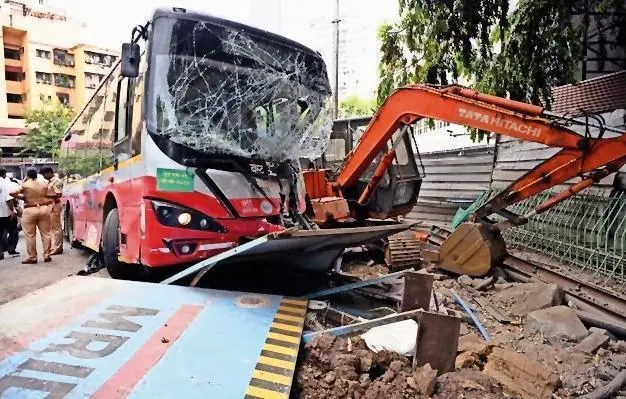
Mumbai: A senior RTO official on Wednesday said that, prima facie, the Dadar bus crash appeared to be the result of ‘driver error’, but he has instructed officials to thoroughly recheck the bus for any technical faults, including issues with the accelerator, brakes, and handbrakes. The RTO also initiated action to suspend the driving licence of driver Vikas Padave, who police have booked for the crash in which one person died and six were injured on Monday.
Sources in RTO said that the bus brakes, when inspected on Wednesday, were found to be in ‘working condition’, but this will be re-checked. Due to less vehicle mobility and wires being cut due to the crash, the engineers of the wet lease operators and BEST were brought in to start the bus.
The RTO will now conduct multiple rounds of inspections on the functioning of various spare parts before coming out with a final report for the city police, a senior official said, adding that during the probe, RTO found that the driver had operated the e-bus on a few rounds before the crash occurred. BEST has also issued show cause notice to wet lease operator in connection with the fatal crash as the undertaking imposes penalties upto Rs 50,000 for every fatal crash.
The driver, Vikas Padave, has reportedly claimed a technical malfunction led to loss of control.
BEST panel member Ajay Singh on Wednesday proposed deploying 125 full-time technicians of the undertaking to maintain all wet-lease buses on a paid basis, improving safety while generating significant revenue. In all the three major crashes in recent years -- Kurla, Bhandup and Dadar-- the buses were electric AC with automatic transmission and on wet lease.
In the Dadar incident, one theory cites inadvertent handbrake release in drive mode with accelerator input, causing sudden acceleration. The Shivaji Park police, who are investigating the case, have formally sought RTO inspection to probe whether “human error” or a technical malfunction caused the deadly BEST electric bus crash.
BEST committee member Sunil Ganacharya said a pattern has been observed in major fatal crashes where drivers lose control as vehicles rapidly pick up speed, something he said is noticed more in electric AC buses with automatic transmission than in CNG or diesel buses. He called for exhaustive training and stringent road tests before drivers are allowed to operate e-buses, especially as the fleet shifts increasingly to electric.
Ganacharya also flagged long working hours for contractual drivers, who may switch between different types of buses, potentially affecting performance. “Drivers of these contractual buses either work for 9-11 hours or after a 6-hour shirt they operate school or tourist buses where the driving system is different and they come back again on the sophisticated e buses the next day. This also is a cause for concern,” he said.
BEST has constituted a four-member team—two senior officials and two engineers experienced in electric buses with automatic transmission—to examine the bus once access is granted.
On compensation, BEST committee chairperson Trushna Vishwasrao has directed that Rs 25,000 be paid immediately to the family of the deceased Swiggy delivery rider, with Rs 2 lakh already given to the family of another victim who remains critical, BEST panel member Ramakant Gupta added.
Mumbai: A senior RTO official on Wednesday said that, prima facie, the Dadar bus crash appeared to be the result of ‘driver error’, but he has instructed officials to thoroughly recheck the bus for any technical faults, including issues with the accelerator, brakes, and handbrakes. The RTO also initiated action to suspend the driving licence of driver Vikas Padave, who police have booked for the crash in which one person died and six were injured on Monday.
Sources in RTO said that the bus brakes, when inspected on Wednesday, were found to be in ‘working condition’, but this will be re-checked. Due to less vehicle mobility and wires being cut due to the crash, the engineers of the wet lease operators and BEST were brought in to start the bus.
The RTO will now conduct multiple rounds of inspections on the functioning of various spare parts before coming out with a final report for the city police, a senior official said, adding that during the probe, RTO found that the driver had operated the e-bus on a few rounds before the crash occurred. BEST has also issued show cause notice to wet lease operator in connection with the fatal crash as the undertaking imposes penalties upto Rs 50,000 for every fatal crash.
The driver, Vikas Padave, has reportedly claimed a technical malfunction led to loss of control.
BEST panel member Ajay Singh on Wednesday proposed deploying 125 full-time technicians of the undertaking to maintain all wet-lease buses on a paid basis, improving safety while generating significant revenue. In all the three major crashes in recent years -- Kurla, Bhandup and Dadar-- the buses were electric AC with automatic transmission and on wet lease.
In the Dadar incident, one theory cites inadvertent handbrake release in drive mode with accelerator input, causing sudden acceleration. The Shivaji Park police, who are investigating the case, have formally sought RTO inspection to probe whether “human error” or a technical malfunction caused the deadly BEST electric bus crash.
BEST committee member Sunil Ganacharya said a pattern has been observed in major fatal crashes where drivers lose control as vehicles rapidly pick up speed, something he said is noticed more in electric AC buses with automatic transmission than in CNG or diesel buses. He called for exhaustive training and stringent road tests before drivers are allowed to operate e-buses, especially as the fleet shifts increasingly to electric.
Ganacharya also flagged long working hours for contractual drivers, who may switch between different types of buses, potentially affecting performance. “Drivers of these contractual buses either work for 9-11 hours or after a 6-hour shirt they operate school or tourist buses where the driving system is different and they come back again on the sophisticated e buses the next day. This also is a cause for concern,” he said.
BEST has constituted a four-member team—two senior officials and two engineers experienced in electric buses with automatic transmission—to examine the bus once access is granted.
On compensation, BEST committee chairperson Trushna Vishwasrao has directed that Rs 25,000 be paid immediately to the family of the deceased Swiggy delivery rider, with Rs 2 lakh already given to the family of another victim who remains critical, BEST panel member Ramakant Gupta added.